

You are here: Home / Extras / Templates / PDFdesigner / Troubleshooting and tips

Templates

Troubleshooting and tips
  • Document feature
    • Check whether the exposé template contains a Document characteristicthat has not yet been assigned to the file. Assign the appropriate document characteristic to the file under Real Estate → Files  .
  • File type
    • Pictures of the file type Photo large are only displayed on pages of the type Individual page type.
    • Pages of type picture gallery only show files of type Photo type.
  • Missing placeholders:
    • Check whether the exposé template contains a placeholder for the file to be displayed (e.g. an energy scale), as some standard templates (such as “Alba”) do not provide for this.
  • File name
    • Avoid The use of underscores (_), spaces, special characters or umlauts (ä, ö, ü) in file names.
    • Underlines can be mistakenly interpreted as macros. Other characters can be replaced in the source code, which prevents the file from being recognized.
  • Maximum number of files:
    • The system can store a maximum of 100 files (including photos, floor plans, site plans, etc.) per property. Files that exceed this number will not be considered.

Changes are not visible

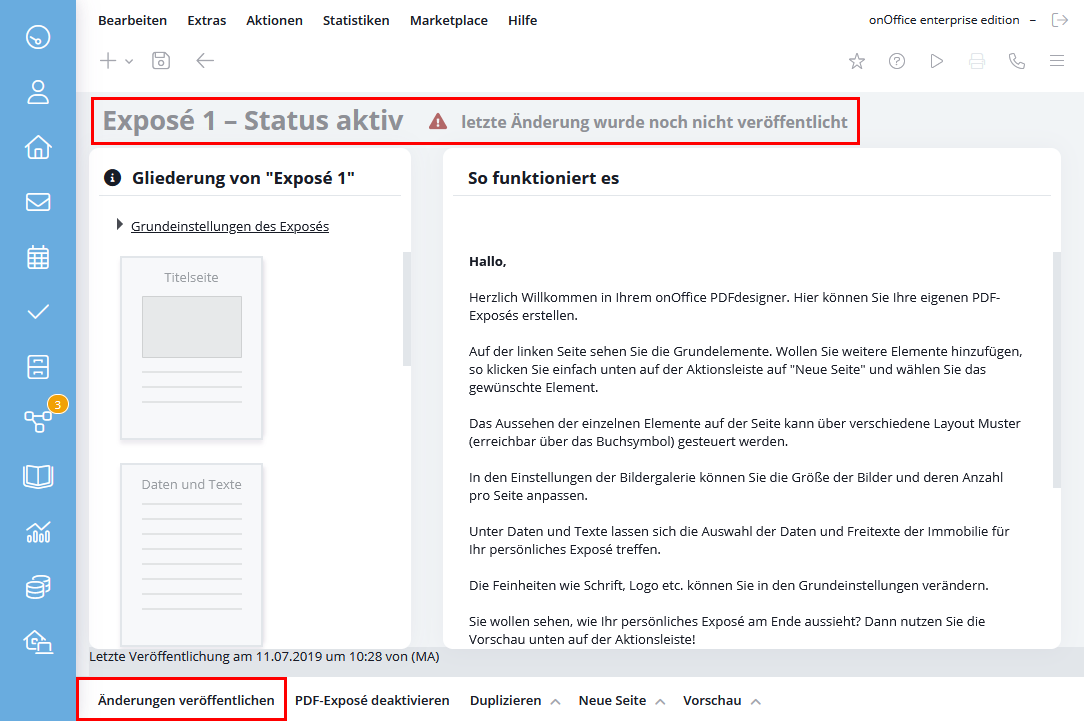
All changes made to Exposé templates in PDFdesigner are initially only visible in the preview.

  • To make the changes visible in the exposé, they must be published be published.
  • Check and publish:
    • A warning next to the title of the exposé template in the PDFdesigner indicates unpublished changes.
  • To publish, click on the “Publish changes”button at the bottom left of your exposé template.

Error message during PDF generation

PDFdesigner - Fehlermeldung Bilder

 In addition to defective or oversized images, other causes can also lead to this error message: 

  • Copied text from third-party software:
    • Cause: When copying text directly from other software, invisible control characters are often copied, which the PDFdesigner interprets incorrectly.
    • Solution: Always copy the text into a text editor first Text editor (e.g. editor) and then from the text editor into the Exposé template to remove these control characters.
  • Individual page without integrated file:
    • Cause: An individual page is configured to display an individual file, but no corresponding file has been included.
  • Logo file:
    • Sometimes it can help to download the logo used in the basic settings, save it again locally and then replace it with this newly saved file in the basic settings.

Definition of contact person

The contact person for a property can be defined in the exposé in various ways:

*Special case for an exposé template with interested party

The contact details usually appear in the footer of the exposé and on a separate contact page.

Footer

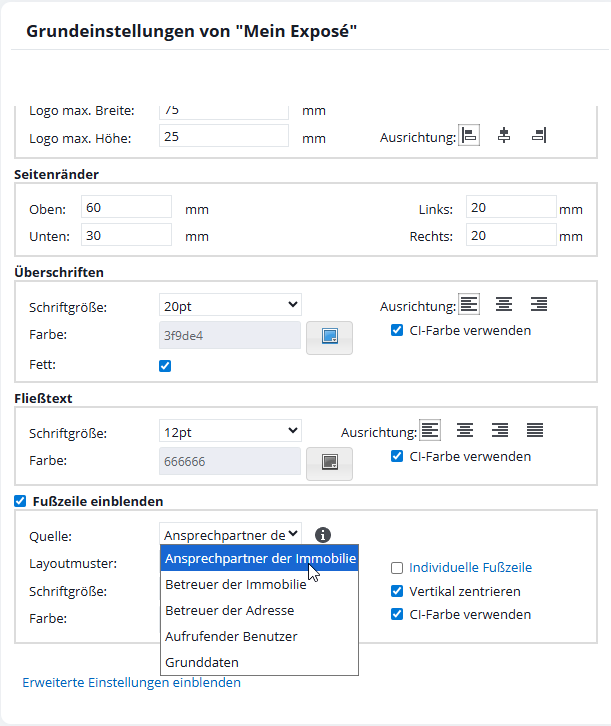
In the brochure basic settings, you can choose from various layouts and specify the desired data source.
If no contact person is entered with the contact type broker, the information from Basic settings → Basic data is automatically used.

Contact page

There are also several layouts to choose from here. Use the “Contact person” dropdown to select the desired contact.
If no broker contact is linked in the object, the PDF Designer also uses the data from Basic settings → Basic data .

Notice: If you are organized in groups, the PDFdesigner first accesses the information from the basic data of the respective group if there is no contact person.

Problems with text formatting and line spacing

  • Ineffective paragraph formatting (e.g. alignment):
    • Cause: The formatted text was most likely transferred from other software.
    • Solution: Copy the text before pasting it into a text program (such as Editor) or enter it again manually.
  • Paragraph formatting grayed out in the CK editor:
    • Solution: Indent the paragraph once, select the desired formatting and then indent the paragraph again.
  • Inconsistent line spacing in a text field(box):
    • Cause: Occurs with multi-line text in a font size other than the standard font size if the font size between {box} and {/box} is changed, but no line break is included.
    • Solution A: Format the beginning {box\} and the end {/box} of the box in the desired font size.
    • Solution B: Insert a line break within the box:
      {box}_objecttitle
      {/box}
PDFdesigner - Line Spacing 2

If text is visible in the synopsis but not in the PDFdesigner

Possible cause 1: The background graphic is colored and the text is formatted in white. As the background is missing in the exposé template view, the white text on a white background becomes invisible.

  • Tips for identification:
    • A scroll bar on the page can indicate invisible content.
    • Mark the entire area; the blue marking background makes the text visible.

Possible cause 2: The text is located in a footer or header or is part of the background graphic.

Inconsistent line spacing in a table

Line spacing is generally not configurable in PDFdesigner. If the spacing within a table is inconsistent, this is often due to formatting (size, color, style) in the first row of the affected cell.

  • Solution:
    • Insert an unformatted blank line after after the content of this table cell.

Clickable links (e.g. Ogulo/Matterport tour) in the exposé

You can download the detailed instructions for inserting a link in the exposé (including masked links, filters and data set characteristics) here .

Conditional image display with if macro

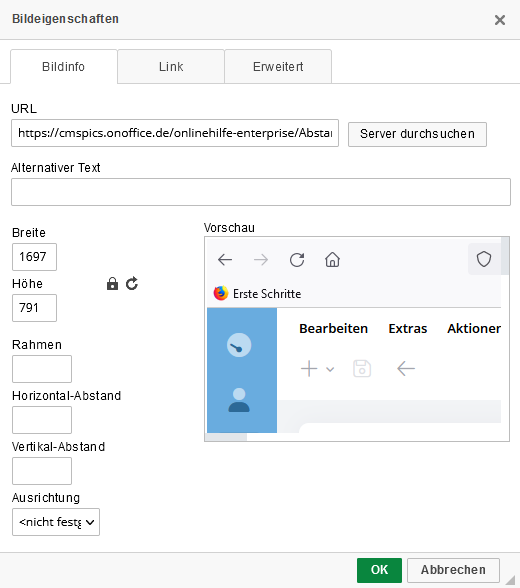
Images can be inserted in the header and footer as well as on a text page using the CK editor. The system generates a link to the image on the server. You will see this link in the window with the image settings.

To the conditional display of the image, the if-Macro can be integrated into the URL line of the image properties, e.g. _if([reserved]; “https://cmspics.onoffice.de/Mandantenname/Bildname”;””)

  • Notice: When using the macro, the image appears as a red square in the preview and only as a frame in the PDFdesigner.
  • Several conditions: Set the individual if-Macros one after the other in the URL line of the image properties to output different images based on different conditions (e.g. sale, rental, reservation). Alternatively, you can use nested if macros here.

Insert a line between two tables or after a table at the bottom of the page

If a table is at the bottom of a text page or you want to add a paragraph between two tables, it is often difficult to position the cursor in the right place.

  • Solution:
    • A dashed line with a red arrow appears below the table. Click on it to insert a new line.

Combine several page types

Different page types can be combined with each other in order to use a page as fully as possible. The “Create page break” checkbox in the page settings controls the page break.

Example data block + free text:

  • The settings on the first page (data block) define the layout of the page (page margins, header and footer, background graphic). 
  • If the Page break on the following free text page is removedthe free text begins immediately below the data block.
  • If the description is longer than the remaining space, a subsequent page is automatically created. This subsequent page adopts settings for page margins as well as header and footer settings for the data block page.

Center text vertically

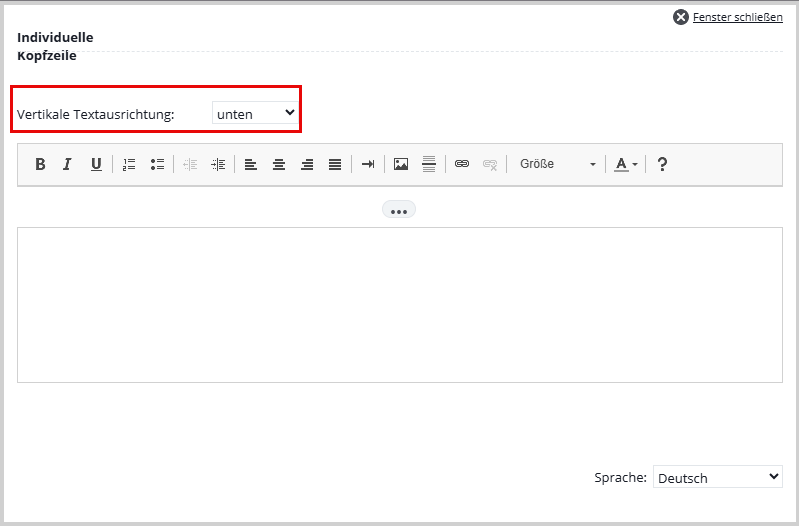
Text can be positioned left-aligned, centered or right-aligned using paragraph formatting in the text editor. The exact position is defined by the margins. Vertical centering on the pageis not possible.

Workaround 1: Top margin

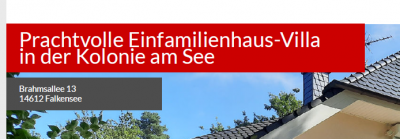
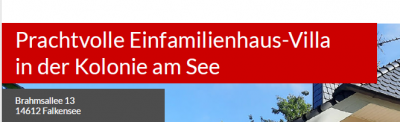
If your text does not exceed a certain length (e.g. a maximum of one line for an object title), you can position the text vertically centered in the middle of the page by adjusting the top margin. 
This procedure can also be applied to the positioning of images on a text page.

Workaround 2:  Use of headers or footers

Header:

  • The configuration is carried out via the basic settings of the brochure template or the advanced settings of the respective page.
  • By default, the header starts at the top of the (paper) page and extends to the defined page margin.
  • Move The distance between the header and the top margin can be adjusted:
    • Header from top: Positive Spacing moves the header down from the edge of the page.
    • Header from bottom: The distance from the page contentis defined. Positive spacing moves the header upfrom the page content. Negative spacing moves the header downfrom the page content.

Footer

  • The footer appears by default between the bottom edge of the page and the bottom edge of the paper.
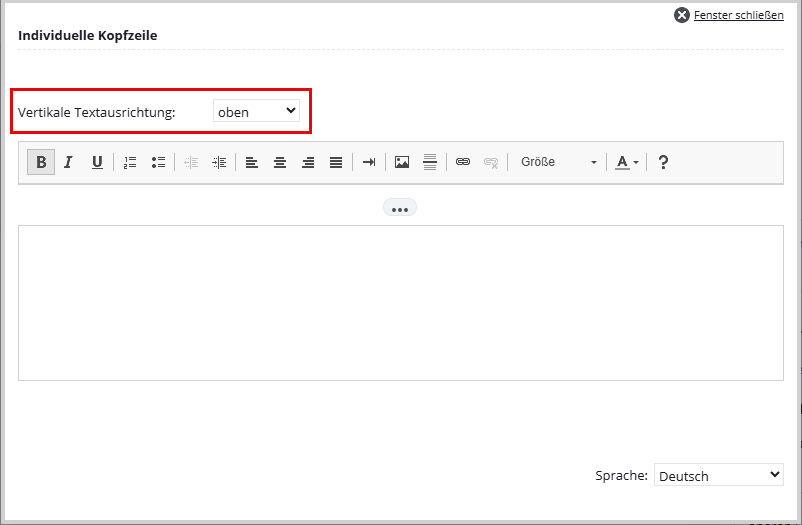
  • Vertically centered: By activating “Center vertically” in the basic settings of an individual footer, a horizontal “baseline” is created in the middle of the page margin and the lines are evenly distributed.

Move elements upwards: To position elements in the footer higher than the set page margin, additional blank lines below the content in the footer.

It is not possible to define the exact distance from the bottom edge of the page or the bottom page content. In the basic settings of the Exposé, only the distance between the page content and the footer can be defined. 

Working with layers

To display individual layouts with the PDFdesigner, text pages, background graphics and headers and footers can be used as layers

  • Level 1 (lowest): Background graphics
  • Level 2: Header(s)
  • Level 3: Text- und andere Layout-Seiten
  • Ebene 4: Fußzeile(n)

Durch geschickte Positionierung der auszugebenden Elemente können Sie Layout-Designs realisieren, die mit einer einzigen Ebene nicht möglich wären.

PDFdesigner-Beispiel Ebenen

Datenblocktabellen

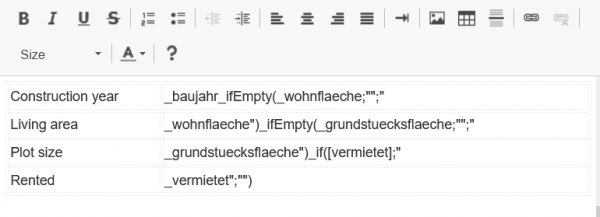
Datenblockdesigns können auch ohne eine feste Datenblockseite dargestellt werden, indem Tabellen auf einer Textseite verwendet werden, die Feldnamen und Feldwerte in separaten Spalten anzeigen.

Bedingte Zeilenanzeige in Tabellen: Hinweise zur Spaltenausrichtung

Soll eine Zeile in Ihrer Tabelle nur angezeigt werden, wenn das entsprechende Feld gefüllt ist, können Sie dies mit if-Makros oder ifEmpty-Makros einrichten. Beachten Sie dabei die unterschiedlichen Regeln für die Spaltenausrichtung:

  • Mit ifEmpty-Makros: Die Funktion ist auch dann gegeben, wenn die Spalten unterschiedlich ausgerichtet sind (z.B. eine Spalte linksbündig und die andere rechtsbündig).
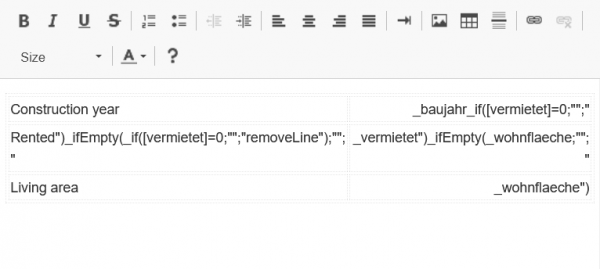
  • Mit if-Makros: Die Funktion ist nur möglich, wenn die Spalten entweder die gleiche Ausrichtung besitzen oder Sie die spezielle Methode verwenden, wie sie im nachfolgenden Bild mit dem “removeLine”-Befehl dargestellt wird, die auch bei unterschiedlicher Spaltenausrichtung funktioniert.

Die erste Zeile einer Tabelle kann nicht wegfallen.

PDfdesigner - Remove line 2

Tabulator-Ausrichtung in Tabellen

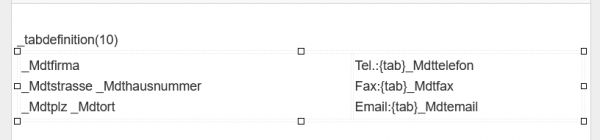
Sie können Tabulatoren nutzen, um einzeilige Texte an einer bestimmten Position linksbündig auszurichten. Dies ist auch in Tabellen umsetzbar. Der entscheidende Punkt dabei ist:

  • Die Tabulatordefinition muss außerhalb der eigentlichen Tabelle festgelegt werden.
  • Anschließend kann der Tabulator  innerhalb der Tabellenzelle genutzt werden, um den Text präzise zu positionieren.

Size of a PDF brochure

  • Die maximale Dateigröße beträgt ca. 90 MB.
  • Wenn die Datei zu groß ist oder die Erstellung zu lang dauert, kann es zu einem Fehler bei der Erstellung des Exposés kommen.

Wie viele Dateien darf ein PDF-Exposé haben?

  • Die Anzahl der Dateien (Bilder und andere Dateien) ist auf maximal 100 Stück pro PDF-Exposé limitiert.

Broschürendruck (Gerade/ungerade Seiten)

  • Automatisch unterschiedliche Inhalte auf geraden und ungeraden Seiten (z.B. linksbündig/rechtsbündig formatierte Seitenzahlen) sind nicht möglich.

Print marks

  • Das Hinzufügen von Beschnitträndern und/oder Druckmarken für den Druck durch eine Druckerei ist nicht möglich.

Line spacing

  •  Die Zeilenabstände können im PDFdesigner nicht individuell beeinflusst werden.

Freitexte (Exposé vs. Webseite):

  • Im direkt aus der Immobilie generierten PDFdesigner-Exposé richtet sich die Anzeige der Freitexte nach den Freitextseiten-Einstellungen.
  • Wird die Vorlage als Download auf der Website verwendet, richtet sich die Anzeige der Freitexte nach den Häkchen in der Administration.

PDF forms – Error message File is not a PDF form

  • Die erforderlichen Formularfelder müssen außerhalb von onOffice mit einer geeigneten Software in die PDF-Datei integriert werden. Nur PDFs mit integrierten Formularfeldern können verwendet werden.

PDF-Formulare – Benennung der Formularfelder

  • Formularfelder sollten sinnvoll und eindeutig benannt werden.